Read Time: 11 min
Finding a centerpiece dining table that combines natural beauty with lasting structural durability is a challenge for many homeowners. Mass-produced furniture often relies on synthetic veneers, uniform dimensional lumber, and artificial finishes that mask the authentic character of natural hardwood. When you invest in your home’s central gathering space, you deserve furniture with genuine presence and timeless craftsmanship.
Custom live edge furniture in Pennsylvania bridges the gap between raw forest architecture and functional interior design. By preserving the living contour, grain ribbons, and natural edge of native hardwoods, every piece becomes a functional work of art.
In this behind-the-scenes guide, you’ll discover how raw hardwood slabs journey through selection, flattening, stabilization, and finishing to become heirloom dining tables built for generations of family meals.
TL;DR / Quick Summary
This guide breaks down how Blue Ridge Furniture transforms raw Pennsylvania hardwood flitches into heirloom live edge tables through kiln drying, precision leveling, bowtie stabilization, and custom joinery.
Key Takeaways:
- Live edge tables preserve the natural cambium perimeter of native hardwoods like Walnut, Oak, and Cherry.
- Proper dehumidification kiln drying to 6%–8% moisture equilibrium prevents warping, twisting, and seasonal cracking.
- Precision CNC surfacing achieves structural tolerances within 1/32″ across the entire tabletop surface.
- Hand-chiseled butterfly keys and epoxy inlays stabilize natural checks while highlighting organic character.
- Underside steel C-channels accommodate natural seasonal wood movement without allowing vertical cupping.
What Is Live Edge Furniture?
Live edge furniture incorporates the natural outer contour of the tree trunk directly into the final design rather than milling the lumber square. Traditional milling squares off the log on every side, cutting away the entire natural edge, bark line, sapwood curves, and contour, to produce uniform dimensional boards. Live edge craftsmanship preserves that natural curve and perimeter instead.
Standard commercial manufacturing prioritizes high-speed uniformity over character. Crafting custom live edge wood furniture means working with the unique grain patterns, checks, and contours inherent to each individual slab.
In our experience across Pennsylvania, every hardwood flitch has its own personality, structural tension, and grain density. Preserving those qualities requires understanding how native species behave across changing seasons.
Step 1: Slab Selection: Where the Design Begins

The creation of a custom table begins in the timber yard with species selection and structural grading. Sourcing the right slab is a fundamental design decision that dictates the proportion, color palette, and character of your finished dining room.
Evaluating Native Hardwood Species
- Black Walnut: Deep chocolate and espresso heartwood contrasted against creamy blonde sapwood, with rich crotch feathering.
- White Oak: Golden-amber tones with prominent medullary rays and exceptional wear resistance for daily use.
- Hard Maple: Bright honey-blonde hues with subtle tiger striping and curly figure that brighten modern dining spaces.
- Black Cherry: Warm reddish-amber tones that naturally deepen into a rich patina when exposed to ambient interior light.
Sourcing, Moisture Grading, and Bookmatching
Moisture content in freshly sawn timber varies widely by species, and can run well above 80% of dry weight before drying begins.[1] Slabs must undergo gradual air-drying followed by dehumidification kiln drying to reach a stable 6%–8% moisture equilibrium before woodworking begins. Skipping this drying phase causes severe warping and splitting once the table enters a heated home.
For standard dining tables, woodworkers select single “monolith” slabs spanning 36″–42″ wide. For expansive conference tables and 10-foot dining tops, craftsmen join two consecutive cuts from the same log to create a mirrored, bookmatched surface down the center seam.
Visit our Honey Brook showroom to talk to us about your project or read this article to learn more about our custom process.
Step 2: Milling and Precision Flattening
Raw kiln-dried slabs naturally develop surface crowns, cups, and subtle twists during moisture loss. For a functional live edge dining table, achieving a perfectly flat planar surface is critical to ensure dinnerware sits level and joinery remains mechanically sound.
- Mechanical Surfacing: The slab is secured to a CNC leveling gantry bed where laser indexing establishes a reference plane. High-speed cutter heads remove high spots in micro-passes to preserve maximum tabletop thickness.
- Hand Planing & Scraping: Woodworkers refine the face using hand planes, card scrapers, and orbital sanders, eliminating tooling marks while enhancing grain depth.
- Planar Tolerances: Blue Ridge craftsmen calibrate tabletop surfaces to maintain structural flatness within 1/32″ across the entire span.
- Structural C-Channel Installation: Slotted steel C-channels are routed into the tabletop underside to prevent vertical cupping while allowing lateral expansion as humidity shifts seasonally.
Technical deep-dive: Wood expands and contracts tangentially and radially across its grain, but experiences negligible movement along its length. Fastening a tabletop rigidly to a steel base with standard wood screws will cause the slab to crack when indoor humidity drops during winter. Installing threaded brass inserts into elongated, slotted holes allows the wood to glide laterally across heavy fasteners without compromising vertical hold.
Step 3: Crack and Void Stabilization
Natural drying checks, knots, and branch unions are normal characteristics of large timber slabs. Rather than treating these as defects, craftsmen use traditional joinery and modern resins to turn them into intentional design highlights.
Structural Butterfly Keys (Bow Ties)
Hand-cut hardwood butterfly keys prevent drying checks from expanding over decades of use. Inlaying contrasting hardwoods, dark Wenge into White Oak, or Maple into Black Walnut, creates an architectural focal point, and the hourglass shape mechanically wedges wood fibers together across the check line.
Deep Void Stabilization with Epoxy
For deep knots, voids, and natural fissures, industrial-grade UV-stable epoxy resin penetrates deep into timber crevices, sealing them against future dirt accumulation. Clients can choose crystal-clear fills that showcase raw interior bark textures, translucent smoke pigments, or opaque matte black resin. The cured resin is planed flush and sanded to 400 grit for a seamless, food-safe surface.
Step 4: Refining and Finishing the Live Edge
Applying finish to a live edge slab requires specialized technique because the outer edge contains face grain, end grain, and cambium fibers that absorb coatings at different rates.
Debarked & Sculpted Edge (Recommended): The natural bark layer is removed with hand drawknives and brass wire brushes, and the sapwood edge beneath is sanded smooth so it won’t catch on clothing or skin.
Stabilized Bark Edge: For decorative mantels or accent consoles, bark can be vacuum-stabilized with penetrating resin, though it isn’t recommended for high-traffic dining tables due to long-term wear.
Blue Ridge Furniture uses high-performance, solvent-based finishes that penetrate and seal the wood for exceptional durability and protection. Unlike water-based finishes, solvent-based coatings provide a deeper, richer appearance while creating a tough protective barrier that resists wine, coffee, water rings, food oils, and everyday wear. The result is a durable, furniture-grade finish that enhances the natural character and beauty of the wood.
Base Options for Live Edge Tables
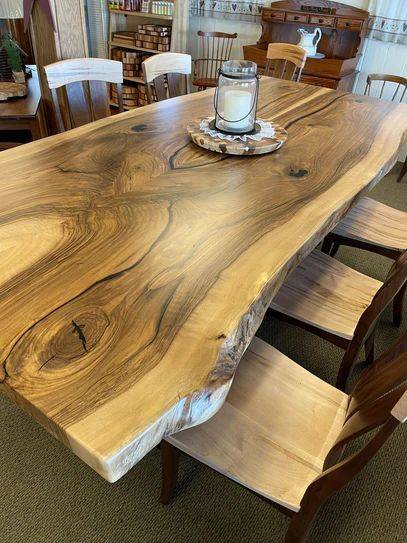
A live edge tabletop weighing between 150 and 350 pounds requires a robust base that provides stability without detracting from the natural grain.
- Welded Steel U-Frames: Matte black powder-coated legs for an industrial aesthetic that pairs naturally with walnut and oak tops.
- Solid Hardwood Trestles: Central trestle bases eliminate corner leg interference and provide generous perimeter seating. Explore sizing guidelines in our dining table dimensions guide.
- Mitered Waterfall Ends: The slab grain cuts at a 45-degree angle and flows continuously to the floor for a striking architectural silhouette.
What You Can Handle vs. When to Call a Pro
Tasks Most Homeowners Can Do
- Routine Cleaning: Wipe down with a soft microfiber cloth, warm water, and mild pH-neutral soap.
- Humidity Management: Keep indoor relative humidity between 35%–55% to minimize wood movement.
- Spot Refreshing: Apply manufacturer-approved maintenance oil to high-traffic areas every 12–24 months.
Tasks for Confident DIYers
- Minor Scratch Repair: Buff light scuffs with 0000-grade steel wool and reapply hardwax touch-up oil.
- Fastener Checks: Inspect and tighten underside mounting bolts annually with basic hand wrenches.
When to Call a Professional
- Initial Slab Flattening: Leveling warped 40″ slabs requires industrial gantry mills and wide-belt calibrating sanders.
- Major Structural Fractures: Severe checks require routing precise mortises for structural butterfly keys.
- Complete Refinishing: Sanding out deep burns or chemical damage requires precision planar sanding to avoid uneven dishing.
Common Live Edge Furniture Mistakes to Avoid
1. Using Inadequately Dried Lumber
What people do wrong: Buying green or partially air-dried slabs from unverified sources for a lower price.
Why it’s a problem: Slabs above 10% moisture will warp, cup, and split as they acclimate to indoor heating.
The right approach: Confirm your builder kiln-dries lumber to 6%–8% internal moisture before fabrication.
2. Fastening Tabletops Rigidly to Metal Bases
What people do wrong: Screwing base plates directly into the top with fixed round holes.
Why it’s a problem: Solid timber expands and contracts seasonally; fixed screws lock it in place and cause splitting.
The right approach: Use slotted mounting brackets and threaded inserts that allow lateral glide.
3. Leaving Unsealed Bark on Dining Surfaces
What people do wrong: Leaving bark intact along high-traffic edges.
Why it’s a problem: Bark degrades, harbors dust, and breaks off in chunks over time.
The right approach: Strip the bark, sculpt the sapwood smooth, and seal the edge.
Conclusion
A handcrafted live edge table in PA is more than everyday furniture; it’s an enduring connection to native hardwood heritage that anchors your home for decades. From timber grading and kiln curing to precision leveling and hand-rubbed finishes, each step protects the structural integrity of your investment.
If you’re ready to design your own custom dining table, contact us on our website or visit the Honey Brook showroom to get your project started.
Based in Honey Brook and serving Lancaster County, Chester County, and surrounding Pennsylvania areas, Blue Ridge Furniture ships worldwide with delivery available up and down the East Coast.
Frequently Asked Questions
What wood species are best for live edge furniture?
Black Walnut, White Oak, Hard Maple, and Black Cherry are the top choices for live edge tables, each selected for different strengths. White Oak and Hard Maple offer excellent hardness and wear resistance for high-traffic dining tables, while Black Walnut and Black Cherry are prized more for dramatic grain figures and rich color; both actually rank softer than Oak or Maple on the Janka hardness scale. The right pick depends on whether you’re prioritizing durability or dramatic appearance.
How much does a live edge dining table cost?
A handcrafted solid wood live edge dining table generally costs between $3,200 and $7,800 or more, depending on species, single-slab versus bookmatched construction, dimensions, void-filling needs, and base materials. Request a custom quote on our website.
What is the difference between live edge and slab furniture?
All live edge furniture is made from hardwood slabs, but not all slab furniture features a live edge. A slab is any thick board sawn lengthwise from a tree trunk. If the natural curves are trimmed square, it’s a standard slab table; if the bark line contour is preserved, it’s a live edge.
How do you stabilize cracks in a live edge table?
Craftsmen inlay hand-chiseled hardwood butterfly keys across splits and fill deep voids with industrial-grade epoxy resin. On the underside, slotted steel C-channels prevent vertical cupping while allowing seasonal expansion.
How long does it take to build a custom live edge table?
Building a custom live edge dining table typically requires 6 to 10 weeks from final slab selection and design approval, accommodating leveling, epoxy curing, joinery, finishing, and delivery.
Does live edge furniture work in a traditional or farmhouse interior?
Yes, live edge furniture adapts across farmhouse, rustic, transitional, and modern industrial interiors. A trestle base creates classic warmth; a steel U-frame delivers a refined contemporary look.
Related Resources
- What Happens After You Say “I Want Custom”: A Look Inside Blue Ridge Furniture’s Workshop
- Furniture Worth Passing Down: How to Choose Heirloom Furniture
- Beyond the Standard Rectangle: How to Design a Custom Table That Fits Your Family
- Why Blue Ridge Furniture is the Go-To Furniture Store in PA
Sources
- USDA Forest Service — Wood Handbook (FPL-GTR-190) — hardwood moisture content and kiln drying standards.
- Penn State Extension — From the Woods: Ten Important Hardwoods — native PA timber species and grain characteristics.